Benutzer:Karina Hetterich: Unterschied zwischen den Versionen
(Die Seite wurde geleert.) |
|||
| Zeile 1: | Zeile 1: | ||
| + | __NOTOC__ | ||
| + | <div style="padding:1px;background: #9FB6CD;border:0px groove;"> | ||
| + | |||
| + | <center><table border="0" width="900px" cellpadding=2 cellspacing=2> | ||
| + | |||
| + | <tr><td width="800px" valign="top"> | ||
| + | |||
| + | == Teste dein Wissen== | ||
| + | |||
| + | === Terme und Zahlen === | ||
| + | <br /> | ||
| + | <quiz> | ||
| + | {1.Vereinfache folgende Terme soweit wie möglich. | ||
| + | | type="{}" } | ||
| + | <math>\frac48 a-( \frac24 a- \frac93 b) =</math> { 3b } | ||
| + | <math> -x(-1-x)-(3+x)(4-x)+12=</math> { "0" } | ||
| + | </quiz> | ||
| + | |||
| + | |||
| + | 2.Setze im ersten Term die Klammern so, dass eine richtige Termumformung entsteht. <br /> | ||
| + | <math>-2a^2+4a \cdot 2 - a = 8a</math> | ||
| + | <popup name="Lösung"> | ||
| + | <math>(-2a)^2+4a \cdot (2 - a) = 8a </math> | ||
| + | </popup> <br /> | ||
| + | <math>-2a^3+2b^3+b^3 = -8a^3+4b^3</math> | ||
| + | <popup name="Lösung"> | ||
| + | <math>(-2a)^3+2(b^3+b^3) oder -(2a)^3+2(b^3+b^3) = 4a^2+4b^3 </math> | ||
| + | </popup> <br /> | ||
| + | |||
| + | |||
| + | 3.Klammere den größtmöglichen Faktor aus.<br/> | ||
| + | <math> 12xy^2-18xy+15x^2y</math> | ||
| + | <popup name = "Lösung"> | ||
| + | <math>3xy(4y-6+5x) | ||
| + | </math></popup><br/> | ||
| + | <math> 4(x+y)+5(2x+2y)</math> | ||
| + | <popup name = "Lösung"> | ||
| + | <math>4(x+y)+5\cdot2(x+y) = (x+y)(4+10)=(x+y)\cdot14 | ||
| + | </math></popup><br/> | ||
| + | |||
| + | |||
| + | 4.Faktorisiere den Term (mit Hilfe der binomischen Formeln)<br/> | ||
| + | <math> 9a^2-30a+25</math> | ||
| + | <popup name = "Lösung"> | ||
| + | <math> 9a^2-30a+25=(3a-5)^2 2.binomische Formel | ||
| + | </math></popup><br/> | ||
| + | <math>9a^4-30a^3+25a^2 </math> | ||
| + | <popup name = "Lösung"> | ||
| + | <math> 9a^4-30a^3+25a^2=a^2(9a^2-30a+25)=a^2(3a-5)^2 a^2 Ausklammern +2.binomische Formel | ||
| + | </math></popup><br/> | ||
| + | <math>9a^2-25 </math> | ||
| + | <popup name = "Lösung"> | ||
| + | <math> 9a^2-25=(3a-5)(3a+5) 3.binomische Formel | ||
| + | </math></popup><br/> | ||
| + | |||
| + | |||
| + | 5. Gib die Definitionsmenge an und vereinfache soweit wie möglich<br/> | ||
| + | <math> \frac{32a^2+a}{a}</math> | ||
| + | <popup name = "Lösung"> | ||
| + | <math>\mathbb{D} =\mathbb{R} \backslash \{0\} \qquad \frac{32a^2+a}{a}=\frac{a (32a+1)}{a}=32a+1 | ||
| + | </math></popup><br/> | ||
| + | |||
| + | <math> \frac{x^4}{x^6(x-2)}</math> | ||
| + | <popup name = "Lösung"> | ||
| + | <math>\mathbb{D} =\mathbb{R} \backslash \{0,2\} \qquad \frac{x^4}{x^6(x-2)}= \frac{1}{x^2(x-2)} | ||
| + | </math></popup><br/> | ||
| + | |||
| + | |||
| + | 6) Vereinfache soweit wie möglich (a>0) <br/> | ||
| + | <math> \sqrt a \cdot (\sqrt a)^3 a^{-3} </math> | ||
| + | <popup name = "Lösung"> | ||
| + | <math> \sqrt a \cdot (\sqrt a)^3 a^{-3} = (\sqrt a)^4 \cdot a^{-3} = a^2 \cdot a^{-3}=a^{2-3}=a^{-1} \frac1 a | ||
| + | </math></popup><br/> | ||
| + | <math> (16^{\frac1 4} a^{\frac1 a})^4</math> | ||
| + | <popup name = "Lösung"> | ||
| + | <math> (16^{\frac1 4} a^{\frac1 4})^4=((16a)^{\frac1 4})^4=(16a)^{\frac1 4 \cdot 4} =16a | ||
| + | </math></popup><br/> | ||
| + | <math> 8^x:2^x</math> | ||
| + | <popup name = "Lösung"> | ||
| + | <math> 8^x:2^x=(8:2)^x=4^x | ||
| + | </math></popup><br/> | ||
| + | |||
| + | |||
| + | === Gleichungen === | ||
| + | |||
| + | Löse die folgenden Gleichungen. Achte auf die Anzahl der Lösungen. <br/>Gibt es nur eine Lösungen, trage in das andere Feld "-" ein.<br/> | ||
| + | Gibt es zwei Lösungen, so ordne diese der Größe nach. | ||
| + | <div class="lueckentext-quiz"> | ||
| + | <math>4x+2=14 \qquad \qquad \qquad \qquad x=</math> ''' 3 ''' / ''' - ''' <br/> | ||
| + | <math> -(x+1)=6-(3-x)\qquad \qquad\qquad x=</math> ''' -2 ''' / ''' - ''' <br/> | ||
| + | <math> 2x^2-30=68\qquad\qquad \qquad x=</math> ''' -7 ''' / ''' 7 ''' <br/> | ||
| + | <math> 6x^2+66=72x\qquad\qquad \qquad x=</math> ''' 1 ''' / ''' 11 ''' <br/> | ||
| + | <math> (x-4)(x- \frac 5 2)=0\qquad\qquad \qquad x=</math> ''' -2,5 ''' / ''' 4 ''' <br/> | ||
| + | <math> 56x+7x^2=0\qquad\qquad \qquad x=</math> ''' -8 ''' / ''' 0 ''' <br/> | ||
| + | <math> x^5=64\qquad\qquad \qquad x=</math> ''' 2 ''' / ''' - ''' <br/> | ||
| + | <math> x^4-3x^3=0\qquad\qquad \qquad x=</math> ''' 0 ''' / ''' 2 ''' <br/> | ||
| + | <math> \frac{15}{x-1}=\frac x 2 \qquad\qquad \qquad x=</math> ''' -5 ''' / ''' 6 ''' <br/> | ||
| + | <math> 3^x=27\qquad\qquad \qquad x=</math> ''' 3 ''' / ''' - ''' <br/> | ||
| + | <math> 3^x=15\qquad\qquad \qquad x=</math> ''' <math> \log_{3}{15} </math> ''' / ''' - ''' <br/> | ||
| + | |||
| + | übrige Lösungen: ''' -3 ''' / ''' 2 ''' / ''' <math> \sqrt{19} </math> ''' / ''' <math> - \sqrt{19} </math> ''' / ''' 6 ''' / ''' -4 ''' / ''' 2,5 '''/ ''' <math> \log_{15}{3}</math> '''<br/> | ||
| + | </div> <br/> | ||
| + | |||
| + | === Funktionen === | ||
| + | 1) Ordne Funktionstyp, Funktionsterm und Funktionsgraph zu <br/> | ||
| + | <div class="zuordnungs-quiz"> | ||
| + | {| | ||
| + | | [[Datei:Quader.svg|120px]] || Lineare Funktion ||<math> f_5(x)=0,5x+1 </math> | ||
| + | |- | ||
| + | | [[Datei:Cylinder (geometry).png|120px]] || Quadratische Funktion ||<math> f_4(x)=0,5x^2+1 </math> | ||
| + | | [[Datei:Cylinder (geometry).png|120px]] || Ganzrationale Funktion ||<math> f_1(x)=x^3+1 </math> | ||
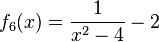
| + | | [[Datei:Cylinder (geometry).png|120px]] || Gebrochen-rationale Funktion ||<math> f_6(x)=\frac {1}{x^2-4}-2 </math> | ||
| + | | [[Datei:Cylinder (geometry).png|120px]] || Gebrochen-rationale Funktion ||<math> f_3(x)=-0,2x^4+0,5x^2 </math> | ||
| + | |||
| + | | [[Datei:Cylinder (geometry).png|120px]] || Exponentialfunktion ||<math>f_8(x)=2^x-0,5</math> | ||
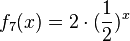
| + | | [[Datei:Cylinder (geometry).png|120px]] || Exponentialfunktion ||<math>f_7(x)=2\cdot (\frac 1 2)^x</math> | ||
| + | | [[Datei:Cylinder (geometry).png|120px]] || Trigonometrische Funktion ||<math>f_2(x)=0,5sinx+1</math> | ||
| + | |} | ||
| + | |||
| + | </div> | ||
| + | |||
| + | |||
| + | <div class="multiplechoice-quiz"> | ||
| + | 2) Entscheide, ob P(3/-6) auf dem Graphen der Funktion <math> f(x)=3x^2-4x-9 </math> liegt. | ||
| + | (Nein. P liegt unterhalb von G<sub>f</sub>) | ||
| + | (!Nein. P liegt oberhalb von G<sub>f</sub>) | ||
| + | (!Ja. P liegt auf G<sub>f</sub>) | ||
| + | </div> | ||
Version vom 29. Juni 2014, 22:18 Uhr
Teste dein WissenTerme und Zahlen
2.Setze im ersten Term die Klammern so, dass eine richtige Termumformung entsteht.
GleichungenLöse die folgenden Gleichungen. Achte auf die Anzahl der Lösungen.
übrige Lösungen: -3 / 2 / Funktionen1) Ordne Funktionstyp, Funktionsterm und Funktionsgraph zu
2) Entscheide, ob P(3/-6) auf dem Graphen der Funktion (Nein. P liegt unterhalb von Gf) (!Nein. P liegt oberhalb von Gf) (!Ja. P liegt auf Gf) |
























 3 / -
3 / -  -2 / -
  -7 / 7
  1 / 11
  -2,5 / 4
  -8 / 0
  2 / -
2 / -  0 / 2
0 / 2  -5 / 6
  3 / -
3 / - 
 / -
/ -  /
/  / 6 / -4 / 2,5 /






 liegt.



.png)